
Yes, it’s worth it. Just maybe not for the reasons people were arguing about in 2016.
The game that shipped in August 2016 was a mess. It was overhyped and missing a lot of what players expected. That version is gone. Ten years and 45+ free updates later, from a small team that could have walked away at any point, it’s a good game. I didn’t expect to be saying that back then.
What No Man’s Sky actually is in 2026
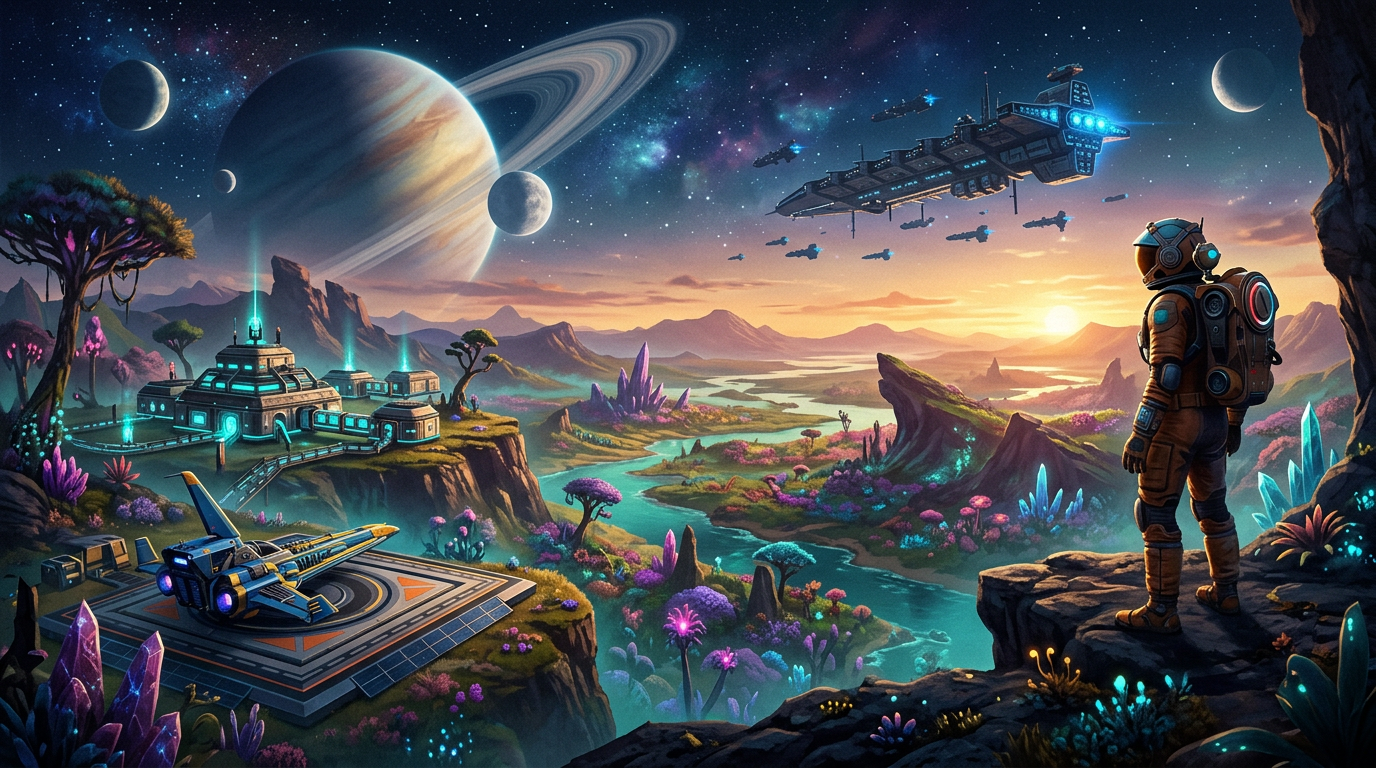
No Man’s Sky is a space survival sandbox. You explore procedurally generated planets, build bases, gather resources, craft equipment, upgrade your ship, and work through an optional story at whatever pace you like. The universe is enormous and technically infinite, though in practice all planets share a limited set of biomes.
Most of your time goes to landing, scanning, gathering, building, upgrading, and moving on. Some players log hundreds of hours doing exactly that. Others bounce off it in ten.
The game runs across PC, PS4, PS5, Xbox One, Xbox Series X/S, Nintendo Switch, Nintendo Switch 2, and even Mac. It supports full cross-play and cross-save. It’s also on Xbox Game Pass, so if you already subscribe, trying it costs you nothing.
The update story
Hello Games has shipped 45+ major named updates since 2016, and every one of them was free to existing owners. No DLC, no paid expansions.
These are the ones that changed the game the most:
| Update | Date | What it added |
|---|---|---|
| Foundation | Nov 2016 | Base building and survival mode. The first sign Hello Games wasn’t walking away. |
| Next | July 2018 | The real relaunch: multiplayer, third-person camera, a rebuilt engine. This is when a lot of people came back. |
| Beyond | Aug 2019 | Full VR support, the Space Anomaly social hub, a big multiplayer expansion. |
| Origins | Sep 2020 | More planet variety, better biomes, storms, abandoned buildings. |
| Waypoint | Oct 2022 | Nintendo Switch launch, difficulty settings, lots of quality-of-life fixes. |
| Worlds Part I | July 2024 | The biggest visual upgrade in the game’s history: volumetric clouds, new planet rendering, better lighting. |
| Voyagers | Dec 2025 | Build and crew your own spaceship with friends, plus skydiving. |
| Remnant | Feb 2026 | The 10th anniversary update. Gravity gun (Gravitino Coil), industrial waste hauling, Colossus truck customization, scrap worlds. |
| Xeno Arena | Apr 2026 | Pokémon-style turn-based creature battles. You capture, train, breed, and gene-edit creatures, then fight other players and NPCs in Holo-Arenas. |
That’s nine out of more than forty-five, and they’re still going.
What the game does well
Exploration is the main event, and the procedural generation is much better than it was. Planets feel distinct in a way they didn’t at launch, and stumbling onto a planet type you haven’t seen before is still a small thrill. Worlds Part I made a big difference here.
Base building is surprisingly flexible for a game at this price. People build everything from tiny survival shelters to sprawling industrial complexes, and there’s a lot of room to get fancy.
The crafting is deeper than it looks. There are efficient and wasteful ways to do almost everything, resource multiplication loops, and long recipe chains that reward you for learning them. The refiner, cooking, and crafting systems have more going on than most games in the genre.
It’s also cheap. Full price is $60, but it regularly drops to $15-25 on sale, and I can’t think of a better deal in the genre.
And it keeps changing. Hello Games updates it on a regular schedule, so the game you buy now will be different in six months.
Who it’s not for
If you want a story-driven game, skip it. There’s a main quest with some interesting lore, but the story is thin and you’ll mostly be making your own fun.
If you need clear objectives, you might struggle. No Man’s Sky gives you a loose progression path and then mostly gets out of the way. There’s rarely a quest marker telling you what to do next. For a lot of players that’s the appeal. For others it’s a dealbreaker.
If you want tight combat, look elsewhere. You can fight Sentinels and space pirates, and it works fine, but it’s not what the game is good at and ten years of updates haven’t changed that.
If slow progress drives you nuts, be warned. The early game is deliberately slow. Getting a good ship, a solid base, and a real grip on the systems takes a while, and players who want to feel powerful right away tend to get frustrated.
The “wide as an ocean” criticism
The most common knock on No Man’s Sky used to be “wide as an ocean, deep as a puddle.” That was fair in 2016 and 2017. It mostly isn’t anymore.
The crafting chain for a Stasis Device involves a dozen intermediate components across multiple farm types. The refining system has hundreds of recipes with efficient and inefficient routes. You can build fairly complex automated farms, and the Xeno Arena now adds a whole creature-battling meta on top of all that.
Exploration holds up too. After the Worlds Part I and II overhauls, landing on a new planet looks and feels a lot better than it did in 2016. People put in 500+ hours and still run into planet types and biome combinations they haven’t seen.
The criticism still sort of applies if you want a narrative or a tightly structured experience, because No Man’s Sky doesn’t curate anything for you. But if you enjoy poking around on your own, there’s plenty underneath.
Price
Full price on Steam is $59.99. It goes on sale constantly and regularly hits $14.99-24.99. The PlayStation and Xbox stores follow similar patterns.
Xbox Game Pass subscribers get it included. That’s the best way to try it with no commitment.
At $60 it’s a fair deal for how much there is to do. At $15 I’d buy it even if you’re only mildly curious.
Verdict
No Man’s Sky rewards patience and players who like setting their own goals. If you’re happy to spend time building, exploring, and slowly tuning your setup, you’ll get hundreds of hours out of it.
If you need clear story objectives, tight combat, or fast progression, look elsewhere.
Hello Games took one of the most controversial launches in gaming and kept working on it for a decade. They’re still adding things like gravity guns and hauling trucks ten years in. I find that pretty remarkable.
Sources
Related
Frequently Asked Questions
Yes, for most players. 45+ free updates have turned it into a deep sandbox with hundreds of hours of content, and it's cheap on sale. If you like exploration, base building, and crafting at your own pace, buy it.
Around $60 at full price, but it goes on sale frequently for $15-25 on Steam and PSN. It's also available on Xbox Game Pass.
Yes. It's mostly a solo game. Multiplayer is there if you want it, but it's optional and you can ignore it entirely.
Remnant (version 6.2), released February 2026. It added the Gravitino Coil gravity gun, industrial waste hauling, Colossus truck customization, and a new expedition.