
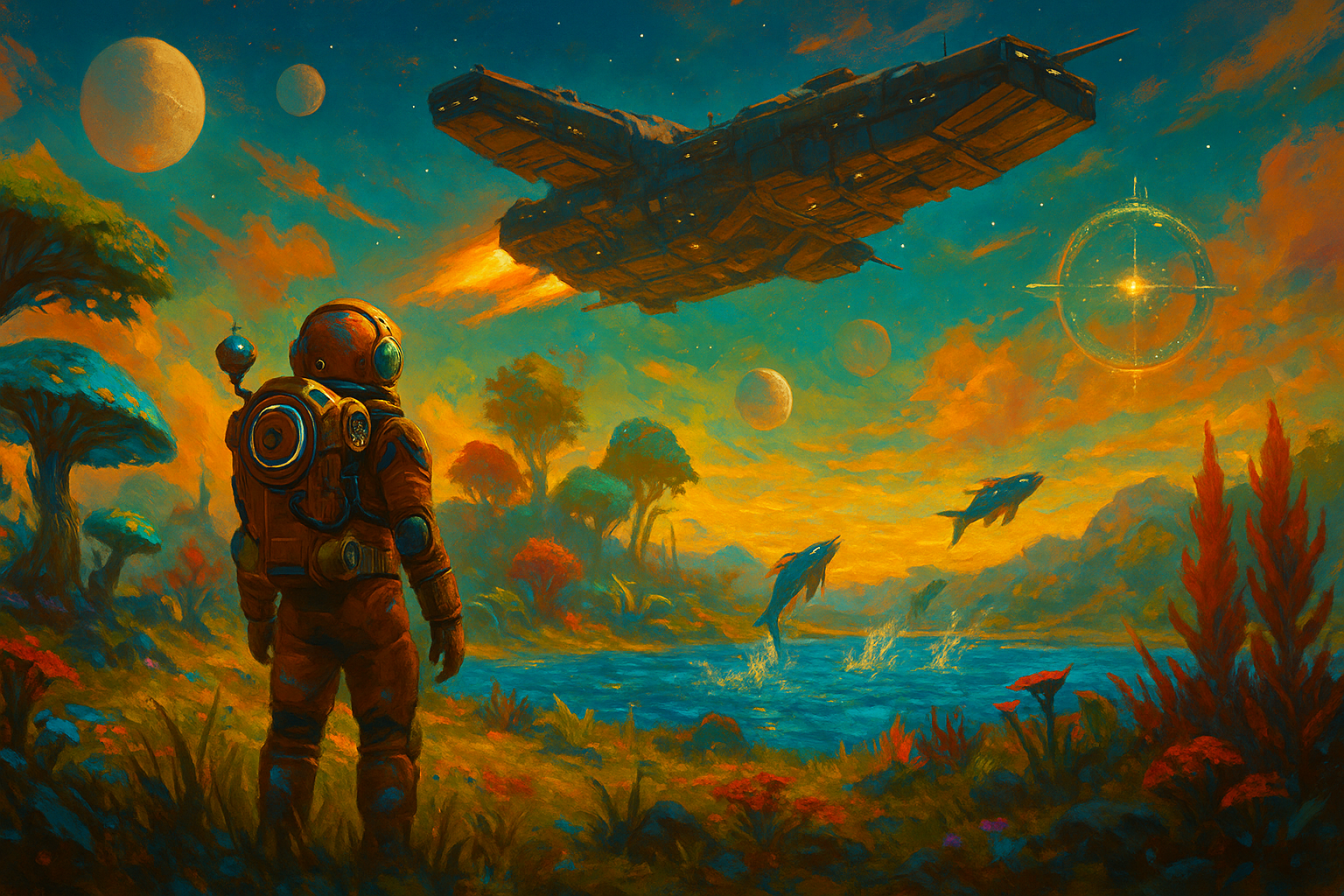
No Man’s Sky launched in August 2016 as a controversial solo experience with big promises and a rough delivery. It’s now April 2026, nearly ten years and over 40 free updates later. If you haven’t played in a while, you’re coming back to a very different game.
This guide lists every major update and what it added, then covers what to actually do when you load back in.
Every No Man’s Sky update at a glance
| Version | Name | Date | What it added |
|---|---|---|---|
| 1.00 | Release | Aug 9, 2016 | Procedural exploration, survival, trading. No multiplayer, very limited base building |
| 1.10 | Foundation | Nov 26, 2016 | Base building, Creative/Survival/Normal modes, freighters, farming |
| 1.20 | Pathfinder | Mar 7, 2017 | Exocraft land vehicles, base sharing online, ship class ratings, Permadeath mode |
| 1.30 | Atlas Rises | Aug 11, 2017 | New story, improved terrain, portal travel, first proto-multiplayer |
| 1.50 | NEXT | Jul 24, 2018 | Full multiplayer, third-person camera, bases anywhere, Xbox launch, graphical overhaul |
| 1.70 | The Abyss | Oct 29, 2018 | Underwater overhaul: new creatures, buildings, submarine, horror narrative |
| 1.75 | Visions | Nov 22, 2018 | New alien biome types, colourful worlds, discoveries catalogue, crashed freighters |
| 2.00 | Beyond | Aug 14, 2019 | Full VR support, Space Anomaly multiplayer hub, NMS 2.0 tech trees, NPCs |
| 2.20 | Synthesis | Nov 28, 2019 | Ship scrapping, tech transfer between ships, inventory improvements |
| 2.30 | Living Ship | Feb 27, 2020 | Organic living ships grown from Void Eggs with unique upgrade system |
| 2.40 | Exo Mech | Apr 8, 2020 | Minotaur mech exocraft, improved terrain manipulator |
| 2.50 | Crossplay | Jul 8, 2020 | Cross-platform multiplayer: PC, PlayStation, Xbox all play together |
| 2.60 | Desolation | Jul 22, 2020 | Derelict freighters: abandoned ships to board and loot |
| 3.00 | Origins | Sep 23, 2020 | Massive planet overhaul: mountains 4× bigger, sandworms, new biomes, binary stars |
| 3.10 | Next Generation | Nov 11, 2020 | PS5 and Xbox Series X: 60fps, ray tracing, faster loading |
| 3.20 | Companions | Feb 17, 2021 | Adopt, name, breed and hatch creature companions from eggs |
| 3.30 | Expeditions | Mar 31, 2021 | New Expeditions game mode with time-limited community challenges |
| 3.50 | Prisms | Jun 2, 2021 | Visual overhaul: reflections, improved lighting, creature fur, new sky effects |
| 3.60 | Frontiers | Sep 1, 2021 | Settlements: player-managed alien villages, reworked build menu |
| 3.80 | Sentinel | Feb 17, 2022 | Complete Sentinel AI rework, mech Sentinels, mechanical companions, new story |
| 3.85 | Outlaws | Apr 6, 2022 | Outlaw systems, solar ships, pirate space stations, smuggling economy |
| 3.94 | Endurance | Jul 20, 2022 | Freighter interiors fully customisable, major fleet and frigate overhaul |
| 4.00 | Waypoint | Oct 7, 2022 | Nintendo Switch launch, complete inventory rework, adjustable difficulty |
| 4.10 | Fractal | Feb 22, 2023 | PSVR2 support, VR visual overhaul, Wonders catalogue |
| 4.20 | Interceptor | Apr 6, 2023 | Corrupted Sentinel ships, Dissonant corrupted planets |
| 4.30 | Singularity | Aug 2023 | Autophage story expansion via ARG-style expedition |
| 4.40 | Echoes | Aug 24, 2023 | Autophage robot race, ownable pirate freighters, new factions |
| 4.50 | Omega | Feb 2024 | Free-to-play event for 8th anniversary, new expedition, improvements |
| 4.60 | Orbital | Mar 27, 2024 | Space station redesign, ship customisation from modular components, guilds |
| 4.70 | Adrift | May 29, 2024 | Expedition in a universe with no NPCs, no active stations |
| 5.00 | Worlds Part I | Jul 17, 2024 | Second planet overhaul: new water tech, fauna, clouds, atmospheric improvements |
| 5.10 | Aquarius | Sep 4, 2024 | Fishing: 200+ fish species, Fishing Rig, Exo-Skiff, Automated Traps, new recipes |
| 5.20 | The Cursed | Oct 23, 2024 | Halloween expedition with cursed planet mechanics |
| 5.25 | Cross-Save | Nov 7, 2024 | Cross-save and cross-play across every platform |
| 5.50 | Worlds Part II | Jan 29, 2025 | Gas giants, water worlds, new star types, ancient ruins, new story |
| 5.60 | Relics | Mar 26, 2025 | Fossil hunting and excavation, improved settlements |
| 5.70 | Beacon | Jun 4, 2025 | Nintendo Switch 2 launch, settlement improvements, new base parts |
| 6.00 | Voyagers | Aug 27, 2025 | Corvettes: massive modular ships with walkable interiors, multiplayer crews |
| 6.10 | Breach | Oct 22, 2025 | New corvette modules, deep-space corvette wrecks for salvage |
| 6.20 | Remnant | Feb 11, 2026 | Gravitino Coil gravity tool, Colossus exocraft overhaul, industrial waste |
| 6.30 | Xeno Arena | Apr 8, 2026 | Creature battles: adopt, train, and fight fauna in the Arena League |
The six updates that mattered most
If you only read about six updates, make it these. Skip any of them and the game will feel noticeably different.
NEXT (July 2018) is where No Man’s Sky became the game it was supposed to be. It added full multiplayer, a third-person camera, bases on any planet, and a big visual overhaul. Very little of the pre-NEXT game survives.
Beyond (August 2019) added VR support, turned the Space Anomaly into a proper multiplayer social hub, and replaced the old blueprint system with tech trees. NEXT rebuilt the foundation. Beyond made the galaxy feel populated.
Origins (September 2020) was the first planet overhaul. Mountains got up to four times bigger, sandworms showed up, and binary and ternary star systems appeared. It was the first time the universe felt properly alien.
Waypoint (October 2022) rebuilt the inventory system from scratch. If you haven’t played since before this, your old save will look scrambled. It also launched the game on Nintendo Switch.
Worlds Part I (July 2024) was the second planet overhaul, and I think it’s a bigger change than Origins. New water tech, new fauna including megafauna, and much better clouds and atmospherics. Every planet looks different now.
Voyagers (August 2025) added Corvettes, the largest ship class in the game. You build them module by module, walk around inside them, and fly them as a mobile base.
What every major update actually changed
Foundation (November 26, 2016)
The first real update after a troubled launch, and the one that proved Hello Games was serious about sticking with the game. Foundation added base building, simple at first and limited to pre-existing sites, but the start of a system that now has hundreds of parts. Three game modes arrived: Normal (the original experience), Creative (unlimited resources, no hazards, pure building), and Survival (brutal difficulty). Freighters became purchasable for the first time, and a farming system let you grow crops in hydroponic labs. Nanite Clusters appeared as a new secondary currency. The quick menu was introduced. None of it sounds dramatic now, but compared to the launch version it was a huge deal.
Pathfinder (March 7, 2017)
Pathfinder added the Exocraft, which are planetary land vehicles. Three launched: the Nomad, Roamer, and Colossus, a hovercraft, an all-terrain buggy, and a cargo hauler. You could now cover a planet’s surface without flying. Ship class ratings (C, B, A, S) arrived too. Base sharing went online, letting other players visit your outpost. Permadeath mode appeared for the first time. Nanite Clusters became properly usable for purchasing tech. New traders appeared in space stations.
Atlas Rises (August 11, 2017)
Atlas Rises was the first update that attempted to give No Man’s Sky a proper story. A new Atlas storyline ran through the game. Terrain generation got much better. Portals became a real system, so you could share a glyph address and teleport to that exact planet from anywhere in the galaxy. A new alien race added more lore. The first taste of multiplayer arrived too: you could see other players as floating orbs in the same system, though you couldn’t interact with them. NPCs started handing out procedural missions, which gave you more to do.
NEXT (July 24, 2018)
NEXT is the update that saved No Man’s Sky. Two years after a disastrous launch, it finally delivered most of what had been promised. Full multiplayer arrived, so you could explore and build with friends or strangers. The third-person camera changed how exploring felt. Bases could be built anywhere on any planet, not just at pre-existing sites, and hundreds of new base parts were added. The game received a major graphical overhaul. No Man’s Sky launched on Xbox for the first time. Freighter armadas (multiple frigates sent on timed expeditions) began the fleet system that still exists today. The Galactic Atlas website launched as a community hub. If you left before NEXT, assume almost everything you remember is out of date.
The Abyss (October 29, 2018)
The Abyss turned the oceans from empty blue voids into actual places worth visiting. New underwater creatures, structures, and resources made diving worth doing, and the Nautilon submarine arrived. There was also a short horror story, darker and stranger than anything else in the game at the time.
Visions (November 22, 2018)
Visions introduced new biome types that made planets far more varied and alien. Bioluminescent plants, new creature types, and a much wider range of colours made exploring more interesting. Crashed freighters appeared on planet surfaces. The discoveries catalogue began tracking everything you found.
Beyond (August 14, 2019)
Beyond was billed as No Man’s Sky 2.0, and it deserved the label. Full VR support arrived, and the whole game became playable in VR on both PC and PSVR. The Space Anomaly became the game’s proper multiplayer social hub, capable of holding 16 players on console and 32 on PC. Tech trees replaced the old blueprint system, which made crafting progression much easier to follow. Multiplayer missions launched from The Nexus aboard the Anomaly. The Pinning system let players track crafting chains step-by-step. NPCs got better dialogue and more variety. Performance improved a lot. And you could finally sit in chairs.
Synthesis (November 28, 2019)
Synthesis was a quality-of-life update. Ship scrapping let you break down unwanted ships for components and units instead of just trading them in. Technology could be transferred between ships. The inventory system improved. Multi-tool upgrades got a cleaner interface. Lots of small annoyances got fixed.
Living Ship (February 27, 2020)
Living Ship added a completely different ship class: organic spacecraft that function more like creatures than machines. You hatch one from a Void Egg through a questline that takes several real-world days. The resulting ship upgrades by growing new organic modules rather than installing standard tech. They have their own abilities and look nothing like conventional ships. If you’ve never seen one, go find one. They’re strange and beautiful.
Exo Mech (April 8, 2020)
Exo Mech added the Minotaur, a mech-style exocraft that handles extreme planetary conditions without the pilot needing to leave the cockpit. It can harvest resources, fight Sentinels, and operate in toxic or radioactive atmospheres that would burn through a standard exosuit fast. The terrain manipulator got a big upgrade at the same time.
Crossplay (July 8, 2020)
Crossplay put PlayStation, Xbox, and PC players in the same universe. Before this, each platform had its own pool. After it, you ran into other players a lot more often.
Desolation (July 22, 2020)
Desolation added derelict freighters: massive abandoned ships drifting in deep space. Board one and you find dark corridors, malfunctioning systems, hostile robots, and environmental hazards including low oxygen. Narrative logs scattered through each derelict tell a story about what happened to the crew. The loot, including rare technology upgrades and valuable components, is some of the best in the game. Derelicts are also the tensest thing in No Man’s Sky. Nothing else in the game feels quite like them.
Origins (September 23, 2020)
Origins was the first major planet overhaul. Players who left before it would barely recognise the worlds they used to explore. Mountains became up to four times taller than the previous maximum. New planets spawned in existing star systems. Binary and ternary star systems appeared for the first time. Sandworms emerged from beneath planet surfaces. Storm gameplay now had beneficial effects alongside hazards. It also added new biomes, creatures, weather, and flora, and gave the UI a full visual refresh.
Next Generation (November 11, 2020)
Next Generation launched No Man’s Sky on PS5 and Xbox Series X with 60fps, ray tracing, 4K, and much faster loading. Existing owners got the upgrade for free.
Companions (February 17, 2021)
Companions gave creatures a real purpose. You could now adopt fauna as companions, name them, level up their traits, and breed them using the Egg Sequencer aboard the Space Anomaly. Companions can mine resources passively, produce materials over time, and serve as mounts. The genetic modification system from this update is what Xeno Arena later built its battle system on.
Expeditions (March 31, 2021)
Expeditions added a new game mode: time-limited community events where all participants start on the same planet with a fresh save and work through shared milestones together. Completing milestones earns exclusive cosmetics (ships, companions, suits, emotes) that can’t be obtained any other way. Over 20 expeditions have run since. Missing one usually means missing its exclusive rewards, though Hello Games has re-run popular ones as holiday redux events. The Expedition Terminus on the Space Anomaly is where you join.
Prisms (June 2, 2021)
Prisms was purely a visual upgrade. It added reflections on ships and bases, much better volumetric lighting, proper creature fur, new sky effects, better warp visuals, and sharper textures. Screenshots from before and after Prisms look like two different games.
Frontiers (September 1, 2021)
Frontiers added Settlements, alien villages populated by NPCs that players can discover, claim, and manage. As overseer, you decide where to build, how to allocate resources, and how to handle crises, and those choices shape how the settlement grows. A well-run settlement generates passive income and works as a second base. The build menu was also reorganized and is much easier to navigate now. Browse all base building parts.
Sentinel (February 17, 2022)
Sentinel rebuilt the Sentinels from scratch. The old ones were mostly passive drones you could ignore. The new ones come in waves of different types (aerial drones, ground walkers, Hardframe mechs) and actually coordinate. Hardframe mechs drop pilot modules when destroyed, and if you collect enough you can build a mechanical companion who fights alongside you. A new storyline uncovered the Sentinel origins and their relationship with the Atlas. Combat felt completely different afterwards.
Outlaws (April 6, 2022)
Outlaws added the criminal side of the galaxy. Outlaw star systems have pirate-run space stations with their own economy, contraband markets, and missions. Solar ships arrived as a new class of lightweight, sun-powered ships with sails. Smuggling finally gave you a reason to visit outlaw space. Pirate raids on freighters became more structured and challenging.
Endurance (July 20, 2022)
Endurance rebuilt freighters from the inside out. Before this update, freighter interiors were fixed and couldn’t be changed. After, they became fully customisable with base-building parts: rooms, corridors, refiners, farms, crew quarters, whatever you want. New frigate types and better expedition mechanics made the fleet worth paying attention to. If you have a freighter from before Endurance, you’ll notice the interior looks completely different.
Waypoint (October 7, 2022)
Waypoint launched No Man’s Sky on Nintendo Switch and rebuilt the inventory system from scratch. The old grid-based inventory (where item size determined how many slots it took up) was replaced with a unified slot system where every item takes one slot. Tech, cargo, and general inventories became clearly distinct. It also added adjustable difficulty settings, so you can tune survival pressure, resource availability, and combat intensity, and save custom presets. For returning players this is one of the updates that matters most, because a pre-Waypoint save will have a completely different-looking inventory when you load it.
Fractal (February 22, 2023)
Fractal added PSVR2 support with a full visual overhaul for VR players. It also introduced the Wonders Catalogue, a persistent record of the most unusual or impressive things you’ve discovered across your travels, from the heaviest creature to the tallest tree to the largest planetary body. If you like collecting, it gives you a list of records to chase.
Interceptor (April 6, 2023)
Interceptor added Corrupted Sentinel ships as a buildable starship class. To find and disassemble them, you explore Dissonant planets, worlds with a distinctive red-glitched aesthetic and uniquely hostile Sentinel variants. The resulting ships look like nothing else in the game. Combat got some improvements too.
Echoes (August 24, 2023)
Echoes introduced the Autophage, a new robot race with their own culture, dialogue trees, lore, and rewards. They’re secretive and harder to find than the Gek, Vy’keen, or Korvax, and building a relationship with them unlocks story content and cosmetics. Pirate freighters also became capturable: board one, fight through it, take out the captain, and it’s yours. The Multi-Staff arrived as a new multi-tool type. If you haven’t met the Autophage yet, there’s a whole faction’s worth of content waiting.
Omega (February 2024)
Omega made No Man’s Sky free to play for a limited period to celebrate the 8th anniversary of the game. A new expedition, bug fixes, balance improvements, and better planetary missions came alongside. The free period brought in a big wave of new players.
Orbital (March 27, 2024)
Orbital redesigned every space station with new architecture and more NPC variety, plus new traders, mission types, and a guild system with standings. The bigger change was modular ship customisation: you can hunt for specific parts and assemble your own ship. Corvettes later took the same idea much further.
Adrift (May 29, 2024)
Adrift was an expedition with an unusual premise: an abandoned universe where NPCs don’t exist, space stations are dark and empty, and you’re truly alone in the galaxy. The loneliness was the point, and it’s still one of the most memorable things Hello Games has made.
Worlds Part I (July 17, 2024)
Worlds Part I was the second major planet overhaul, and in some ways a bigger one than Origins. Oceans got proper wave physics, and new cloud rendering made the skies look fantastic. Megafauna (creatures that dwarf you) changed how planets feel on the ground. More terrain variety and more biome subtypes made planets more distinct from each other. Systems people had explored for years suddenly looked different.
Aquarius (September 4, 2024)
Aquarius added fishing: over 200 species spread across 8 biomes, four rarity tiers, and a depth-based size mechanic. The Fishing Rig is a Multi-Tool attachment purchased for 1 Nanite from Iteration Eos at the Space Anomaly. The Exo-Skiff provided a deployable water platform. Automated Traps let you fish passively. New seafood recipes for the Nutrient Processor gave you something to do with your catch. Rare fish sell for up to 50,000 units each and legendary fish up to 200,000. The full fish catalogue and food items are on the site, and the fishing guide covers the rest.
The Cursed (October 23, 2024)
The Cursed was a Halloween expedition running for roughly two weeks with unique mechanics around cursed planetary conditions. Exclusive cosmetics were available, some of which returned in the Holiday 2024 expedition redux.
Cross-Save (November 7, 2024)
If you’re returning on a different platform, Cross-Save is the update you care about. No Man’s Sky now supports cross-save and cross-play across every platform: PC via Steam and GOG, PlayStation 4 and 5, Xbox One and Series, Game Pass, Nintendo Switch, Steam Deck, and PSVR. You can start on PC and carry on on console without losing progress.
Worlds Part II (January 29, 2025)
Worlds Part II added whole new planet types. You could visit gas giants for the first time, huge swirling worlds with their own conditions and resources. Water worlds, planets almost entirely covered in ocean, appeared with new underwater terrain. New star types brought new system aesthetics. Ancient ruins scattered across planets added new lore artefacts. A new story thread ran through the update.
Relics (March 26, 2025)
Relics added fossil hunting. Relic sites on planets hold the skeletal remains of ancient alien creatures, scannable and excavatable with a visor tool. Completing a full specimen rewards rare materials and lore about the creature. Settlement mechanics also improved with more building variety, more decision types, and the addition of infestation events.
Beacon (June 4, 2025)
Beacon launched No Man’s Sky on Nintendo Switch 2 with better visuals. Settlements got more management options, and there were new base building parts.
Voyagers (August 27, 2025)
Voyagers added Corvettes, the biggest ship type in the game. Built module by module at the Corvette Workshop inside any Space Station, a Corvette is a massive ship with real interior sections you walk around in. Install refiners, storage, and decorations. Crew it with other players in multiplayer. Scan planets from the cockpit without landing. Plenty of players now use them as flying bases instead of a permanent one on a planet. Every corvette part is on the site, and the Corvette guide covers building one.
Breach (October 22, 2025)
Breach expanded the Corvette system with new module types and added corvette wreck sites in deep space: zero-gravity salvage missions where you exit your ship to strip parts from abandoned Corvettes floating between stars. A Halloween expedition with its own progression ran alongside.
Remnant (February 11, 2026)
Remnant added the Gravitino Coil, a gravity manipulation attachment for the Multi-Tool. With it you can magnetise, carry, and launch physical objects: industrial waste, golden artefacts from ruins, Sentinel drones in combat. Planets with salvageable scrap now also generate industrial waste that you collect and process at new Waste Processing Plants for materials and rewards. The Colossus got a big overhaul too, with customisable cabins, chassis options, paint finishes, and new modules like a flatbed for hauling waste and a furnace for processing it on the road.
Xeno Arena (April 8, 2026)
Xeno Arena added the creature battle system. Adopt wild fauna using Creature Pellets (or Ion Batteries for mechanical creatures), build a team of three, and fight at Holo-Arena tables found at space stations, planetary outposts, and the Space Anomaly. Eight elemental affinities (Fire, Frost, Radioactive, Toxic, Tropical, Anomalous, Mechanical, Desert) determine matchups. Creatures earn experience through battles and can be genetically modified using Retroviral Pellets. The Arena League faction tracks your ranking. Iteration: Oceanus at the Space Anomaly hosts daily challenges. The Xeno Arena guide has the details.
What you’ll find when you return, by era
| You left around… | What you’ll recognise | What will be completely new |
|---|---|---|
| Launch, 2016 | The basic loop: land, mine, sell, warp | Multiplayer, base building, VR, companions, settlements, fishing, Corvettes, creature battles. Basically everything |
| NEXT era, 2018–2019 | Multiplayer, third person, basic bases anywhere | Space Anomaly as a hub, VR, the full tech tree system, Companions, Expeditions, Prisms visuals, Frontiers settlements, all 2021+ content |
| Origins era, 2020–2021 | Better planets, companions, expeditions | Sentinel rework, Outlaws and pirate factions, Endurance freighter interiors, Waypoint inventory overhaul, Echoes Autophage race, all 2022+ content |
| Waypoint era, 2022–2023 | New inventory system, difficulty settings, Sentinel combat, settlements | Echoes Autophage race, Orbital ship building, Worlds planet overhaul, fishing, Corvettes, Remnant, Xeno Arena |
| Worlds era, mid 2024 | Planet overhaul, fishing, ship building | Worlds Part II gas giants and water worlds, Relics fossils, Corvettes, Remnant Gravitino Coil, Xeno Arena |
| Voyagers era, Aug 2025 | Corvettes, Breach salvage missions | Remnant Gravitino Coil, Colossus overhaul, Xeno Arena creature battles |
Things that changed and will confuse you
Some core systems work differently enough now to trip you up.
Inventory (Waypoint, October 2022)
Before Waypoint, some items took 1 slot and some took 2. Now everything takes 1 slot. Exosuit, Ship, and Multi-Tool inventories are still separate, but your old save will look rearranged when you load it.
Space stations (Orbital, March 2024)
Every space station was redesigned, so whatever layout you remember is gone. The Corvette Workshop is through the blue teleport columns on the left side of the shop area.
Sentinels (Sentinel, February 2022)
If you remember Sentinels as passive drones you could ignore, they’re now a real fight, with escalating waves, mech types, and coordinated AI. A four-star wanted level will test you. It’s a good change, but it’ll catch you off guard.
Portal interference (Origins, September 2020)
Portals used to stop you from calling your ship after you used one. Origins removed that, so you can use portals without getting stranded.
Ship building (Orbital, March 2024 onwards)
You don’t have to find a pre-built ship anymore. You can salvage parts and assemble your own, or build a Corvette from scratch at the Workshop.
What to do when you first load back in
Check these five things first.
-
Your tech slots. Big updates sometimes break old technology, and anything with a warning icon is hurting your stats. Dismantle it and reinstall.
-
The Space Anomaly. It’s the main hub and gets new NPCs with most major updates. Talk to Iteration: Oceanus to pick up the Xeno Arena tutorial quest. Check the Quicksilver Synthesis Companion for new cosmetics. Look at the Expedition Terminus to see if a current expedition is running. If one is, you can join partway through.
-
The Wonders Catalogue. It tracks your catch records, fossil discoveries, creature records, and more. While you’re at it, check on your companions. They need feeding.
-
Your settlement. If you claimed one before leaving, decisions have piled up while you were gone. Clear the backlog in the management panel to get it running again.
-
The build menu. Nearly every update adds base parts, so if you like building, there’ll be plenty you’ve never seen.
What still works exactly the same
The core money-making loops have survived every update. If you had a working setup, it still works.
The Chlorine loop hasn’t changed: 1 Chlorine + 2 Oxygen refines into 6 Chlorine in any refiner. Feed the output back as input and your stack multiplies every cycle. Sell at any Galactic Trade Terminal for millions of units per session. The full list of refiner recipes and the crafting calculator are on the site.
Nanite farming works the same too. Refine Runaway Mould from Curious Deposits, or collect and refine Tainted Metal. The Nanite farming guide has details.
If you had a fleet, your frigates have been sitting idle. Send them out from your freighter command room and they’ll come back with resources, units, and now sometimes Corvette parts.
Everything you built is still there, and base building works the same way, just with a lot more parts.
Portal travel still works with player-shared glyph addresses, minus the old stranding problem.
The three systems worth learning immediately
These are the biggest additions since 2022, and you’ve probably never touched any of them: fishing, Corvettes, and Xeno Arena.
Fishing
Added in Aquarius (September 2024). Get the Fishing Rig blueprint from Iteration Eos at the Space Anomaly for 1 Nanite, craft it (3x Carbon Nanotubes + 1x Di-hydrogen Jelly + 60x Chromatic Metal), and you can fish in any body of water. Shallow water produces small and medium fish; deep water produces large and colossal. There are over 200 fish species across 8 biomes, with legendary fish selling for up to 200,000 units each. Full breakdown in the fishing guide.
Corvettes
Added in Voyagers (August 2025). The Corvette Workshop inside any Space Station (via the blue teleport columns on the left side) lets you build a massive modular ship from parts. You walk around inside it, decorate it, install refiners and storage, and crew it with other players. Buying all the basic parts from the Workshop costs roughly 7.6 million units, but salvaging from scrap planets cuts that down a lot. Full breakdown in the Corvette guide.
Xeno Arena
Added April 8, 2026. Adopt wild creatures, build a team of three, and fight at Holo-Arena tables at space stations, planetary outposts, and the Space Anomaly. Eight elemental affinities determine matchups. Rewards include Nanites, Retroviral Pellets for upgrading creature genetics, and exclusive companions from Iteration: Oceanus. Full breakdown in the Xeno Arena guide.
Should you start a new save?
I’d start fresh if you left before Waypoint (October 2022). The inventory changed so much that your old save will feel off. A new save also walks you through the newer systems (Corvettes, fishing, Xeno Arena) properly, where an old save assumes you already know them.
If you left after Waypoint, keep your save. The inventory change won’t affect you, your bases and ships are intact, and your currency carries over. You just need to catch up on the new stuff.
Either way, thanks to Cross-Save (November 2024) you can play on any platform without losing progress.
Sources
- Official No Man’s Sky release log
- Individual update pages linked throughout above
Related
Frequently Asked Questions
No Man's Sky has received over 40 major named updates since launch in August 2016, plus hundreds of smaller patches. The most recent is Xeno Arena (version 6.3), released April 8, 2026.
Yes. The game in 2026 is almost unrecognisable from launch. It has full multiplayer, VR, fishing, creature battles, modular Corvette ships, completely overhauled planets, cross-save across every platform, and 40+ free content updates.
If you left before Waypoint (October 2022), starting fresh is worth considering since the inventory system was completely reworked. If you left after Waypoint, your save will be fine. Just check your tech slots for any broken upgrades when you load in.
Xeno Arena (version 6.3), released April 8, 2026. It adds a full turn-based creature battle system, the Arena League faction, 8 elemental affinities, and daily challenges hosted by the new NPC Iteration: Oceanus.
The six most transformative updates are: NEXT (July 2018, full multiplayer and third person), Beyond (August 2019, VR and Space Anomaly hub), Origins (September 2020, planet overhaul), Waypoint (October 2022, inventory rework and Switch launch), Worlds Part I (July 2024, second planet overhaul), and Voyagers (August 2025, Corvette ships).