
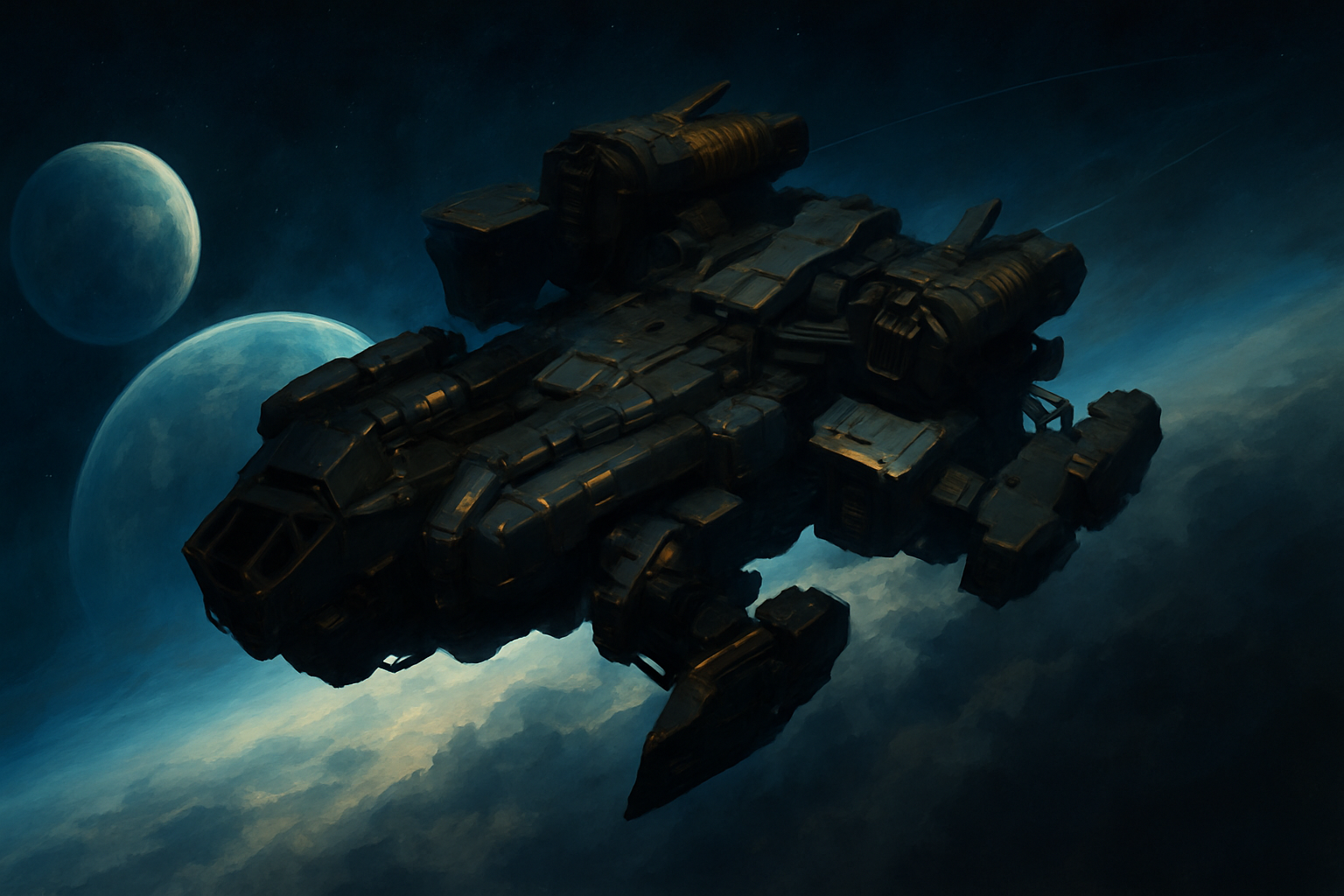
Corvettes were added in the Voyagers update (version 6.0, August 2025). They’re fully modular spaceships you assemble part by part at the Corvette Workshop in any Space Station. You can walk around inside them, decorate the interior, install a refiner, and scan planets from the cockpit without landing. Plenty of people treat theirs as a flying base. Every corvette part is listed on the site if you want to browse.
Finding the Corvette Workshop
Every Space Station has a Corvette Workshop. When you land, head toward the shops and look for the four blue teleport columns on the left side. Step through one to reach the Workshop terminal.
The Workshop has three main options. Purchase Basic Modules sells starter parts for Units with no RNG. Trade Advanced Modules lets you swap spare modules for rarer ones. Create New Corvette starts construction once you have enough parts.
There’s also a Workshop Cache with over 100 storage slots dedicated to Corvette modules. Anything in the cache appears as available when building or trading, so move parts there to keep your exosuit inventory clear.
What you need to build one
A Corvette needs these parts to be valid:
| Part | Minimum needed | Workshop price |
|---|---|---|
| Landing Gear | 2 | ~420,000 units each |
| Thruster | 2 | ~400,000 units each |
| Cockpit | 1 | 1,600,000 units |
| Access Module (Landing Bay) | 1 | 800,000 units |
| Habitation Module | 1 | 680,000 units |
| Reactor | 1 | 1,750,000 units |
| Main Engine | 1 | 1,000,000 units |
| Weapon System | 1 | 1,200,000 units |
Buying everything from the Workshop costs at least 7,630,000 Units. You don’t have to buy it all, though. Salvaged parts from planets and derelict freighters work just as well, and they’re often rarer modules you can’t buy anyway.
How to get parts without spending 7 million units
The best free source is Salvageable Scrap on planets. When scanning a planet from space, check the Planetary Data list for Salvageable Scrap. Land and look for yellow flags (same icon as Buried Technology Modules, tinted yellow). Mine the casing and you’ll get technology drops. The central case in each scrap site guarantees a Corvette module.
Derelict freighters are the next best. The Engineering Control station inside a derelict has an option to Fabricate Corvette Modules. What you get is random, but it can be a rare module you can’t buy at all.
Pirates drop modules too, alongside their regular loot, and frigate missions occasionally bring some back.
For your first Corvette, I’d buy the basics from the Workshop to get started, then replace purchased modules with better salvaged ones over time. The Workshop lets you swap parts out without rebuilding from scratch.
Building your Corvette
Once you have the required parts, select Create New Corvette at the terminal. You’ll enter a build mode with an empty bay. Place Landing Gear first, then build outward. The required parts tracker in the upper-right corner shows what’s still missing.
You get up to 160 parts, which is plenty. Symmetry doesn’t matter either: the ship flies the same whether it’s balanced or lopsided. Get the functional parts on first and worry about looks later.
When you’re done, finalize the build. The Corvette gets added to your starship collection and takes up one starship slot. You can edit it again any time at any Corvette Workshop.
Which modules are worth having
Cockpit
There are three design styles: Titan, Ambassador, and Thunderbird. They differ in aesthetics and stat weighting. Titan gives the highest Boost percentage. Ambassador is better for Maneuverability. Both are 1,600,000 Units from the Workshop, so pick whichever design you prefer and upgrade later.
Main engine
The Arcadia Heavy Booster is the best all-around engine, with the highest Maneuverability and Booster strength. You can’t buy it, so you’ll have to find it through salvage or trading.
Reactor
Each reactor type trades off differently:
| Reactor | Best for |
|---|---|
| Ceto-Class | Shield strength |
| Zenith-Class | Warp distance |
| Medusa-Class | Maneuverability |
| Azimuth-Class | Pulse Engine performance |
If you warp a lot, take Zenith. If you spend a lot of time in combat or tight spaces, Ceto or Medusa.
Habitation modules
Every Hab gives +3 inventory slots, and walkways give +1. Stack as many as you like up to the 160-part limit. Extra inventory is never wasted.
Hull attachments
Cargo modules are the only hull attachments that affect gameplay. The rest are decoration.
Weapon system
The Photon Cannon Array is the basic buyable option. Phase Beam and Torpedo Launcher are alternatives depending on combat preference. This choice only affects combat.
Upgrading your Corvette’s class rating
The Corvette starts at C-class. To raise it:
- Set the Corvette as your primary ship
- Go to the Starship Outfitting Terminal at any Space Station
- Pay Nanites to upgrade one tier at a time
The first upgrade costs 10,000 Nanites. Getting from C to S-class costs roughly 85,000 Nanites across all steps. That’s a real grind, so make sure you’re happy with the design before you start paying.
S-class gives the highest stat ceiling, but the modules themselves matter as much as the class rating. A well-built C-class with the Arcadia Heavy Booster will outperform a poorly-built S-class in most situations.
What the Corvette actually changes
Once you have one, the Corvette replaces the Exocraft for most planetary exploration. You fly low, scan from the cockpit without landing, and jump straight out the side hatch onto the surface. Exocraft start to feel pretty redundant after that, though the Pilgrim and Nomad are still better for dense, close-range terrain.
The interior is what sets it apart from every other ship. You can install a Refiner Unit inside, set up storage, and build it out as a mobile base. As of update 6.2 (Remnant, February 2026), other players in multiplayer can help decorate your Corvette interior, and you can redecorate while the ship is in flight.
Sources
Related
Frequently Asked Questions
Go to any Space Station and take the blue teleport columns on the left side of the shop area to reach the Corvette Workshop console. Buy the basic modules you need, then select Create New Corvette to start building.
Buying all required basic modules from the Workshop costs around 7,630,000 Units. You can reduce this significantly by salvaging parts from scrap on planets, derelict freighters, and pirate drops.
At minimum: 2 Landing Gear, 2 Thrusters, 1 Cockpit, 1 Landing Bay (Access Module), 1 Habitation Module, 1 Reactor, 1 Main Engine, and 1 Weapon System.
Set your Corvette as your primary ship, then visit the Starship Outfitting Terminal at any Space Station. Upgrading to S-class requires approximately 85,000 Nanites across multiple upgrade steps.