
On this page
Starship fuel questions in No Man’s Sky usually come down to three resources, and the names don’t help. Deuterium, Tritium and Di-hydrogen all sound like the same hydrogen, and they sit side by side in your inventory. Only one of them, Tritium, goes straight into a tank, and Deuterium doesn’t fuel your ship at all. This guide covers where to get each one, how to make NMS Deuterium in a refiner, and which fuel goes into which engine.
The short version:
| Engine | What charges it | Per unit |
|---|---|---|
| Launch Thruster | Starship Launch Fuel or Uranium | 100% or 2.5% |
| Pulse Engine | Tritium or Pyrite | 0.5% or 2.5% |
| Hyperdrive | Warp Cell or Warp Hypercore | 20% (one jump) or a full tank |
Deuterium isn’t on that list, which surprises a lot of people.
How to get Di-hydrogen
Di-hydrogen is the easy one. The in-game text says it’s common to all worlds and grows as large blue crystals. Hit your Scanner and nearby crystals show up on the HUD as a blue H. A basic Mining Laser handles most of them, but the largest crystals need the Advanced Mining Laser.
A few other sources, per the Fandom wiki:
- Some ordinary minerals carry it as a secondary element once you’ve checked them with the Analysis Visor.
- Galactic Trade Terminals in pirate-controlled systems sell it.
- Some terminals sell Di-hydrogen Jelly in bulk, and 1 jelly refines back into 40 Di-hydrogen.
You can also refine it from Tritium: 5 Tritium makes 1 Di-hydrogen. That’s a bad trade unless you’re sitting on a mountain of Tritium and the nearest blue crystal is a planet away.
One loop people ask about: 30 Di-hydrogen refines into 1 jelly, and 1 jelly refines into 40 Di-hydrogen. On paper that’s free Di-hydrogen. The wiki notes the Fractal update nerfed this, and in the game data the jelly-to-Di-hydrogen step takes far longer than the other direction. Crystals are quicker.
How to get Tritium
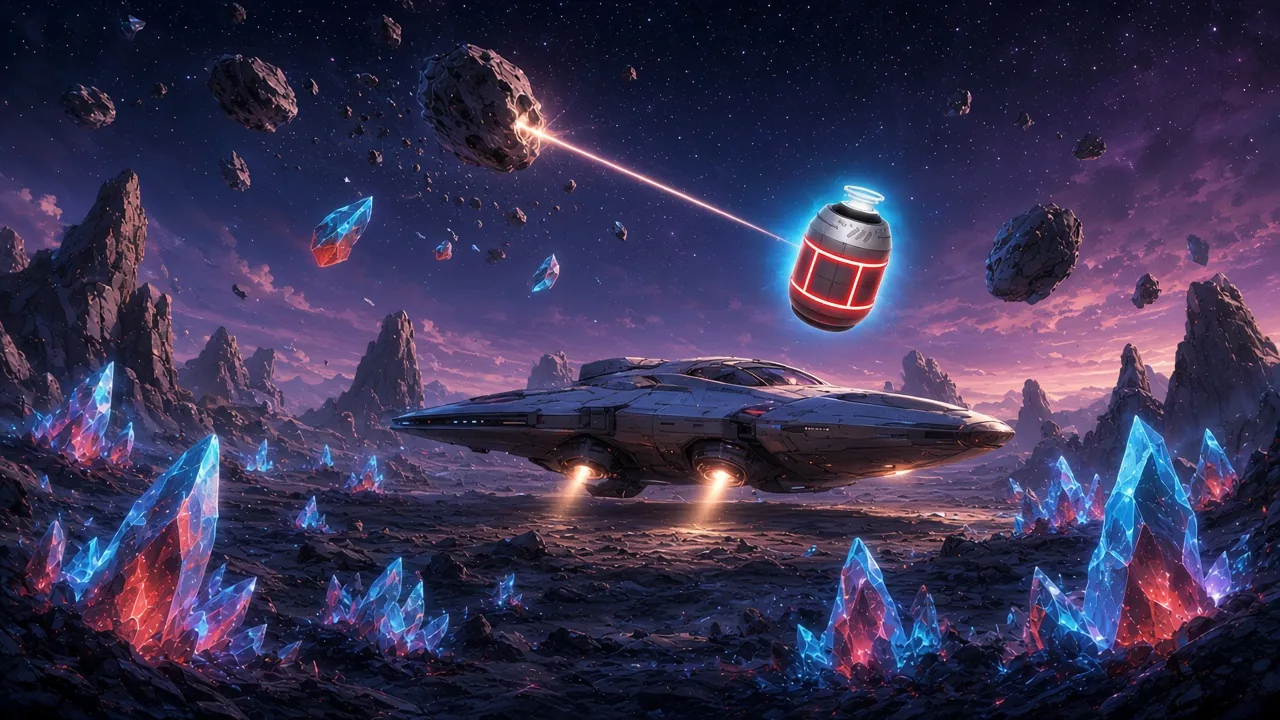
Tritium comes from space. Its in-game text says it’s abundant in interstellar asteroid fields and that you mine it by shooting asteroids with your starship weapons. Scan in space and tritium-rich asteroids get marked.
Asteroids sometimes drop a Tritium Hypercluster too, described as a shard of pure crystallised Tritium. Crack it open from your inventory. The wiki says it usually breaks into a stack of Tritium and occasionally gives Antimatter instead.
No refiner recipe outputs Tritium, so you can’t make it from something else. If you hate asteroid shooting, the wiki says small amounts are always for sale in outlaw systems, and a newly bought starship or freighter can come with some on board.
How to make Deuterium
Deuterium very rarely occurs naturally. The game’s own description says most of the galaxy’s supply comes from refining Di-hydrogen and Tritium, and that’s still the way to do it. There are two recipes:
| Inputs | Output |
|---|---|
| 1 Di-hydrogen + 1 Tritium | 1 Deuterium |
| 1 Di-hydrogen + 1 Silicate Powder | 1 Deuterium |
Both take two inputs, so the Portable Refiner can’t do them. Use a Medium Refiner or Large Refiner.
I’d go with the Silicate Powder recipe. It arrived in the Adrift update, and Silicate Powder is everywhere: the item text says it’s in the rock of all rocky worlds, and you get it by digging a tunnel with the Terrain Manipulator. That saves your Tritium for the Pulse Engine. Tritium makes sense only if you’re already floating in space with a full stack.
If you remember Deuterium-rich plants giving you Deuterium directly, the wiki says that was patched out shortly after the NEXT update. Touching those blue plants now just gives your jetpack a short boost.
What Deuterium is actually for
Here’s the confusing part. The Launch Thruster’s in-game text says it needs “specialised, Deuterium-derived fuel.” But Starship Launch Fuel is made from Di-hydrogen, and no Deuterium goes into it. You can play for hundreds of hours without putting Deuterium in your ship.
Where it does show up, according to the game data:
| Technology | Deuterium needed |
|---|---|
| Pulse Spitter (Multi-Tool weapon) | 200 |
| Incinerator (Multi-Tool weapon) | 200 |
| Vesper Sail (starship) | 125 |
| Neutron Shielding (Exocraft) | 95 |
If a blueprint sent you looking for Deuterium, it was probably one of those.
Launch Thruster fuel
Every takeoff from open ground costs Launch Thruster fuel. One Starship Launch Fuel fills it to 100%, and Uranium gives 2.5% per unit if you’re stuck. Launching from a landing pad, or from one of the marked landing spots with blue rings, costs nothing.
You can craft Starship Launch Fuel from 40 Di-hydrogen and 1 Metal Plating. The refiner versions use a lot less Di-hydrogen:
| Refiner inputs | Output |
|---|---|
| 10 Di-hydrogen + 20 Ferrite Dust + 5 Sodium Nitrate | 1 Launch Fuel |
| 10 Di-hydrogen + 20 Pure Ferrite + 10 Sodium | 1 Launch Fuel |
| 10 Di-hydrogen + 10 Magnetised Ferrite + 5 Sodium Nitrate | 1 Launch Fuel |
These are three-input recipes, so you need a Large Refiner. If you have one at your base, it’s a quarter of the Di-hydrogen per canister.
Two upgrades cut down how often you refuel. Efficient Thrusters lowers takeoff cost. The Launch Auto-charger slowly refills the thruster while the ship is parked. The wiki puts that at 4% per minute, and only while the ship is grounded and set as your primary.
Pulse Engine fuel
The Pulse Engine runs on Tritium at 0.5% per unit, so an empty tank takes 200. Pyrite gives 2.5% per unit if you happen to have some from a desert world. Normal boosting is free; the fuel only drains while you Pulse Jump.
Keep a stack of Tritium in the ship’s inventory. You’ll be passing asteroids constantly, and topping up mid-flight is easier than landing to dig.
Hyperdrive fuel
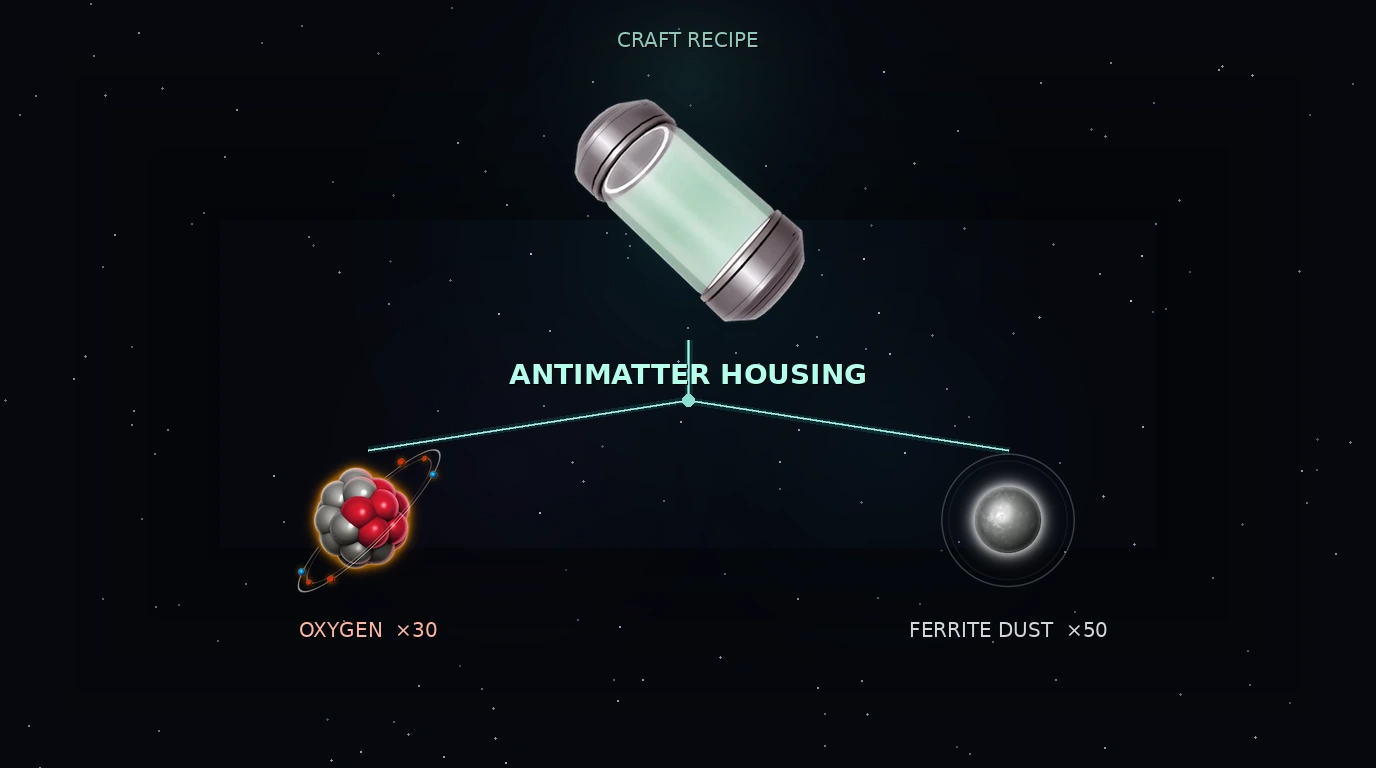
The Hyperdrive doesn’t use any of these three directly. A Warp Cell is crafted from 1 Antimatter Housing and 1 Antimatter, and each cell is 20% of the tank, so one jump. A Warp Hypercore, made from 1 Antimatter and 1 Storm Crystal, fills the whole thing.
The Antimatter Housing guide covers that chain.
Frigate fuel
If you run a fleet, Di-hydrogen and Tritium matter for one more reason. Frigate fuel is equal parts of both: Frigate Fuel (50 Tonnes) takes 50 of each, the 100-tonne barrel takes 100 of each, and the 200-tonne barrel takes 200 of each. That’s a real Tritium sink, so mine more than you think you need.
Every refiner recipe here is also listed on the refining page.
Sources
- Deuterium (Fandom)
- Tritium (Fandom)
- Di-hydrogen (Fandom)
- Di-hydrogen Jelly (Fandom)
- Starship Launch Fuel (Fandom)
- Launch Thruster (Fandom)
- Pulse Engine (Fandom)
- Hyperdrive (Fandom)
- Warp Hypercore (Fandom)
- Tritium Hypercluster (Fandom)
- Launch Auto-charger (Fandom)
- Extracted game data: item text, recipes and charge values for Deuterium, Tritium, Di-hydrogen, Starship Launch Fuel, Launch Thruster, Pulse Engine and Hyperdrive
Related

More guides
Frequently asked questions
Refine 1 Di-hydrogen with 1 Tritium, or 1 Di-hydrogen with 1 Silicate Powder. Each makes 1 Deuterium. Both recipes have two inputs, so you need a Medium or Large Refiner, not the Portable one.
Shoot asteroids with your starship weapons. The game says Tritium is abundant in interstellar asteroid fields, and your starship scanner marks tritium-rich asteroids. No refiner recipe makes Tritium.
On every planet, as large blue crystals. Press the Scanner and nearby crystals show up as a blue H. The biggest crystals need an Advanced Mining Laser.
Starship Launch Fuel fills it to 100% with one unit. Uranium works too, at 2.5% per unit. Taking off from a landing pad costs no fuel at all.
Not directly. The Launch Thruster's in-game text says it needs Deuterium-derived fuel, but Starship Launch Fuel is actually made from Di-hydrogen. Deuterium goes into tech like the Vesper Sail, Pulse Spitter, Incinerator and Neutron Shielding.
Tritium at 0.5% per unit, or Pyrite at 2.5% per unit. The fuel only drains during a Pulse Jump, not when you boost.